Kill Shot Bravo: 3D Sniper FPS
- 4.4
- Rating
- 50.00M
- Installs
- Free
- Price

 Analysis by App-foxy
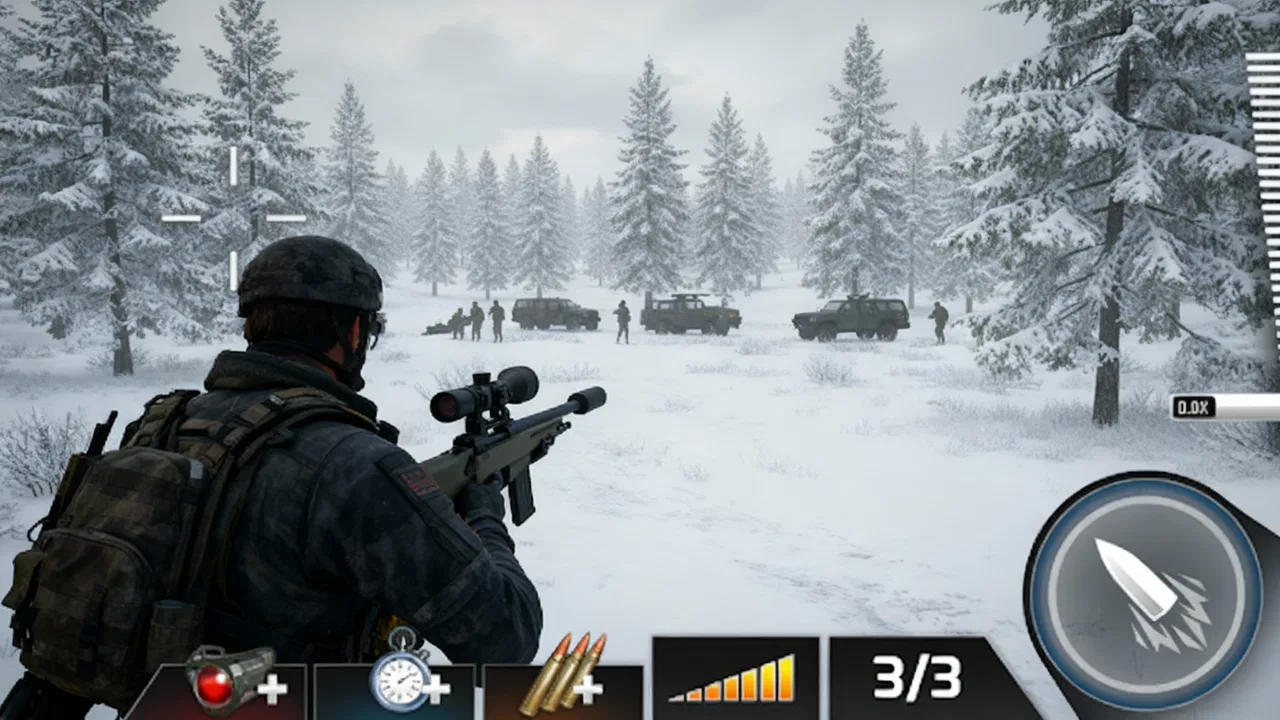
Kill Shot Bravo is the kind of action game that makes a strong first impression because it gets you into a mission quickly. I spent my opening sessions moving through compact shooting scenarios, lining up targets, and learning how much patience each encounter rewards. It is free to start, belongs to the action category, and comes from Supercharge Mobile. The basic appeal is easy to understand: you take the role of a military sniper, choose a target, and try to finish the job before the situation gets away from you.
That simple loop is also the reason I kept returning during the first week. A short session can feel complete, which suits the moments when I have only a few minutes available. At the same time, the game adds enough variety through different army locations and multiplayer-oriented play to stop the opening hours from feeling like one identical shooting gallery. It is not a slow tactical simulation, and it is not trying to be a large open-world shooter. Its identity is much more focused: quick, dramatic sniper action on a mobile screen.
The store page presents it as an online multiplayer player-versus-player sniper shooter with a range of maps and modes. In practice, that description points toward the main question for a long-term player: is the moment-to-moment shooting satisfying enough to survive the initial novelty? My answer is qualified. The first-week experience is immediately accessible, but lasting value depends on whether you enjoy repeating precision challenges and gradually improving your results.
You May Also Like

 Blood Strike: 2.5 Anniversary
Blood Strike’s Loadouts Turn Every Drop Into a Tactical Gamble
A close look at Blood Strike’s custom loadouts: how fast access to signature weapons reshapes its battle royale rhythm, rewards preparation, and narrows the gap between fights.

 Pandora - Music & Podcasts
Pandora’s Music Is Easy to Start, but Harder to Recover
Pandora’s strength is its low-effort path from a seed to a station. Its weak spot is how much confidence it asks you to place in connection, setup, and quiet recovery.

 8 Ball Pool
 Is Built on Rivalries, Rematches, and Routine
A close look at the rivalries, rematches, shared routines, and unanswered safety questions that turn a quick pool match into a persistent mobile community.

 Samsung Music
’s Quiet Strength Is Playing What You Already Own
Its reach comes less from spectacle than from dependable access to a personal library. That simplicity is both the app’s strongest retention engine and its ceiling.

 AccuWeather: Weather Radar
AccuWeather Review: A Quick, Clear Forecast for Everyday Decisions
For everyday plans, the best forecast is the one you can understand quickly. AccuWeather makes rain timing, radar, and local conditions easy to act on, with a few trade-offs.

 Hill Climb Racing
Why Hill Climb Racing Still Turns Crashes Into One More Run
A tiny car, a bumpy hill and one more upgrade: Hill Climb Racing keeps resurfacing because its simple chaos makes every near-miss feel personal.
More From Our News Desk



What the first week feels like
I’d use the first week to notice not just whether the shots feel satisfying, but whether I’m choosing to return when I have other quick games available. That distinction helps separate genuine interest in the aiming rhythm from the pull of simply having unfinished progress. Once that early routine settles, the next question is whether the game still earns a place in my short breaks.
Fast missions and an easy learning curve
The opening is friendly to people who do not normally play shooters on a phone. You do not need to understand a complicated control scheme before taking your first shot. The central action is readable: observe the scene, position your aim, and fire at the right moment. That clarity matters on a touchscreen, where an overloaded interface can make a game feel tiring before it becomes enjoyable.
I found the early missions particularly effective as short breaks. A player waiting for a bus, taking a lunch pause, or winding down before bed can complete a few attempts without committing to a long match. The compact structure also makes failure less frustrating than it would be in a lengthy campaign. When a shot goes wrong, I generally understood what I needed to improve rather than feeling that the entire session had been wasted.
The sniper viewpoint gives ordinary targets more tension than a standard run-and-gun setup. You are not simply moving forward while holding down the fire button. The pause before a shot creates a small decision: should I wait, aim more carefully, or take the opportunity now? That rhythm is one of the strongest reasons to try this game, especially if you prefer deliberate shooting over constant movement.
Why the presentation works at first
Its military framing provides a clear context for the missions, while the 3D presentation helps each location feel more substantial than a flat target board. I would not describe the visual style as a substitute for a console shooter, but it does enough to make the act of scanning a scene and selecting a target feel purposeful. The game communicates its objective quickly, which is useful when playing without sound or with only partial attention.
The variety of maps and modes is important during the opening stretch. Even when the underlying action remains familiar, a change of setting or objective can give a mission a different mood. That variety does not completely transform the core loop, but it reduces the sense that every attempt is merely the same target placed in a new position.
There is also a useful balance between spectacle and control. The game wants shots to feel dramatic, yet the player still needs to make the important decision. If you enjoy the satisfaction of a carefully timed hit, the first sessions provide enough feedback to make improvement visible. If you want complex movement, deep weapon handling, or a broad story campaign, this narrow focus may feel lightweight from the beginning.
What I would do before spending anything
Because the game is free, I recommend treating the opening period as a test rather than assuming that an in-app purchase is necessary. Play long enough to learn whether the basic aiming loop itself holds your attention. If you already feel bored when the missions ask you to repeat similar precision tasks, extra content or faster progress will not solve the underlying problem.
The listed in-app purchases range from $0.99 to $94.99 per item. That wide range makes restraint sensible. I would first identify the part of the game I actually enjoy—careful single-player-style missions, competitive play, or collecting progress—and only then consider whether spending improves that particular experience. A purchase should remove a specific annoyance for you, not become a reflex after a difficult attempt.
Parents should also note the Mature 17+ rating. The military combat theme and violent action are central to the experience, not incidental decoration. For an adult player looking for a quick shooter, that may be expected. For a younger player or a family device, I would choose something with a more suitable rating instead of relying on the colorful presentation to make the content seem harmless.
Does it retain value after the novelty fades?
For me, lasting value comes down to whether repeated missions keep giving me a reason to sharpen my timing rather than merely continue a routine. I’d check in occasionally instead of forcing daily play, and see whether different maps or competitive sessions still feel like a meaningful change of pace. That makes it easier to judge the game on its own focused strengths, not on how long I have kept it installed.
The month-to-month appeal
After the first excitement settles, the game becomes a test of personal habits. I can see a regular player opening it for a few missions each day, especially someone who likes measurable improvement. The appeal comes from refining timing, recognizing patterns in an encounter, and trying to perform more consistently rather than simply discovering a new world.
The online player-versus-player side can add a different kind of motivation. Competing against other people gives a successful shot more weight than completing a predictable objective. It also changes the emotional pace: a mistake feels more personal, and a strong round can create the urge to try again immediately. Players who enjoy leaderboard-style pressure may find that this is what keeps the game installed after the campaign-style novelty weakens.
However, competitive play is not automatically better for everyone. If you prefer a relaxed game with no pressure to react or improve, the multiplayer angle may turn a casual break into a frustrating routine. I would approach it as an optional source of challenge rather than the only reason to keep playing. The game is most comfortable when you can switch between focused shooting and lighter sessions instead of forcing yourself into competition every time.
Three ways to make repeated play less repetitive
My first practical tip is to alternate the kind of session you play. Use one visit to concentrate on accuracy and another to explore a different mode or map. This sounds simple, but it prevents the game from becoming a single mechanical exercise. The variety is more useful when you deliberately rotate it rather than exhausting one format until it feels stale.
Second, treat difficult attempts as practice in observation, not only as tests of reflex. Before firing, look for the safest moment and consider what caused the previous failure. Sniper games often reward waiting more than rushing, and this title is more enjoyable when I approach each scene as a small timing puzzle. That mindset also helps reduce the temptation to spend money merely because I missed a shot.
Third, set a stopping point before starting a session. The short missions make it easy to say “one more,” particularly after a near-success. A fixed limit keeps the game in its best role as a compact action break and protects it from becoming repetitive. In my experience, leaving after a satisfying attempt makes it more appealing the next time than continuing until every mission starts to blur together.
Where the long-term friction appears
The biggest limitation is repetition. Even with different maps and modes, the central activity remains aiming and firing from a sniper perspective. That is a strength when you want exactly that experience, but it becomes a weakness if you need constant mechanical change. Players who usually move between driving, platforming, exploration, and close-range combat may find the focus too narrow for daily use.
Progression can also create friction when the game places more importance on continued advancement than on the pleasure of the individual shot. If a weapon, mission, or competitive result feels out of reach, the temptation is to hurry through the slower parts or consider a purchase. I prefer to play at a pace where improvement comes from my decisions. Anyone who dislikes resource pressure or repeated attempts should pay attention to how they feel during the first week, because that reaction is likely to become stronger over time.
Another source of fatigue is the emotional pattern of precision play. A missed shot can be more irritating than a defeat in a chaotic action game because the mistake feels concentrated in one decision. That can be satisfying when I know I was close, but exhausting when several attempts fail for the same reason. The game is better suited to players who can accept repetition as part of learning than to those who want constant success during a short break.
Maintenance, updates, and device expectations
The current version is 14.6.1, and the game supports devices running Android 6.0 or later. That broad minimum requirement makes it approachable for people using older compatible phones, although the experience can still vary depending on the device. A 3D action game with online elements is more demanding in practice than a simple puzzle title, so I would keep expectations realistic on aging hardware and test performance before committing to regular competitive play.
Maintenance is not only about installing updates. A player also has to manage attention: remember where they left off, decide which modes deserve time, and resist turning every session into a chase for progress. That is the hidden cost of a game designed for repeated visits. Its short missions make it convenient, but convenience can also encourage habitual checking without delivering much satisfaction.
I would keep it installed on a phone used for occasional gaming if the aiming feels responsive and the online side remains enjoyable. I would be less enthusiastic about making it a permanent fixture on a device with limited storage, weak performance, or an unreliable connection. For this particular game, smooth control and stable interaction matter more than they would in a turn-based alternative.
Who should choose it, and who should skip it?
I recommend it to adults who like sniper-focused action, compact missions, and the possibility of competing with other players. It is especially suitable for someone who wants a game that can be played in short bursts but still offers a reason to improve. The free entry point makes it easy to judge the core loop without making an immediate commitment.
I would steer away from it if you are looking for a story-heavy military adventure, a realistic simulation, or a shooter built around constant movement and team coordination. It is also a poor match for anyone sensitive to repeated target scenarios or uncomfortable with the Mature 17+ content rating. A slower strategy game may be better for thoughtful planning, while a conventional multiplayer shooter may suit players who want broader movement and more direct combat.
The comparison with those alternatives is useful. A traditional mobile shooter usually gives you more freedom to move, react, and fight at close range. Kill Shot Bravo instead narrows the action to the moment of choosing and taking a shot. That makes it less versatile, but it also gives it a distinct purpose. I would not replace every other action game with it; I would use it when I specifically want a focused sniper session.
My long-term verdict
The game has earned its popularity, with an average rating of 4.4 from around 635 thousand ratings and more than 50 million installs. Those figures suggest that its straightforward shooting loop connects with a large audience, and my own experience explains why: it is quick to understand, easy to sample, and satisfying when a careful shot works.
Still, popularity does not remove the central trade-off. The same focused design that makes the first week approachable can make the later weeks feel repetitive. Its lasting value depends on whether you enjoy the discipline of improving aim, revisiting maps and modes, and occasionally testing yourself against other players. If that sounds like a pleasant routine, the game can remain a dependable short-session action title. If you need constant novelty, it will probably become an app you revisit briefly before moving on.
Supercharge Mobile has built something more specific than a general shooter: a mobile sniper game that turns small decisions into the main event. I like that clarity, and I appreciate being able to play without reserving a large block of time. My recommendation is to download it for the free trial experience, play without rushing into purchases, and judge your reaction after the first excitement has passed. Keep it installed only if the act of improving one shot at a time still feels rewarding.
For me, that makes it a qualified recommendation rather than an automatic one. It is a good fit for adult players who want focused action and a repeatable competitive edge, but it is not the best choice for broad shooter variety or a deep campaign. When its limitations match your preferences, they feel like concentration. When they do not, no amount of extra progression will make the narrow loop feel wider.
FAQs for Kill Shot Bravo: 3D Sniper FPS
01What is Kill Shot Bravo: 3D Sniper FPS about?
Kill Shot Bravo is a third-person sniper shooter focused on completing military-style missions around the world. You take the role of an elite operative, eliminate marked targets, rescue hostages, collect intelligence, and fight enemy forces. The game combines precision shooting with action sequences, weapon upgrades, different environments, and a campaign structure designed for short, mission-based play sessions.
02Can Kill Shot Bravo be played offline?
Some parts of Kill Shot Bravo may be accessible without a constant internet connection, but online access is generally recommended and may be required for certain features. Multiplayer events, leaderboards, cloud-related functions, advertisements, updates, and in-game purchases typically depend on an internet connection. Availability can also vary by device and game version, so offline functionality should not be assumed for the entire experience.
03Is Kill Shot Bravo free to download and play?
Kill Shot Bravo is generally free to download, allowing players to begin the campaign without paying an upfront purchase price. However, it includes optional in-app purchases for items such as currency, weapons, upgrades, or other advantages. Progress can be made without spending money, although players may encounter waiting periods, limited resources, advertisements, or difficulty increases that encourage optional purchases.
04Does Kill Shot Bravo contain violent content or mature themes?
Yes. Kill Shot Bravo is built around military combat and sniper missions, so its gameplay includes firearms, enemy eliminations, explosions, blood effects, and other forms of stylized violence. The presentation is action-oriented rather than realistic in every detail, but it may still be unsuitable for younger players. Parents should check the age rating and review device-level purchase controls before installation.
05What devices are recommended for playing Kill Shot Bravo smoothly?
The game can run on many modern Android and iOS devices, but performance depends on the phone or tablet’s processor, graphics hardware, available storage, operating system, and memory. Newer devices generally provide smoother aiming, faster loading, and more stable frame rates. Before downloading, make sure sufficient storage is available and install the latest compatible version from the official app store.
Pros
- Large variety of missions across detailed global locations.
- Wide selection of sniper rifles and weapons to unlock.
- Smooth aiming controls work well on touchscreen devices.
- Regular events add new objectives and rewards.
- Offline missions are available for some gameplay modes.
Cons
- Energy limits can interrupt longer play sessions.
- Weapon upgrades may require significant grinding.
- Some missions become repetitive after extended play.
- Ads can appear frequently between activities.
- Online features require a stable internet connection.

Kill Shot Bravo: 3D Sniper FPS
Gallery